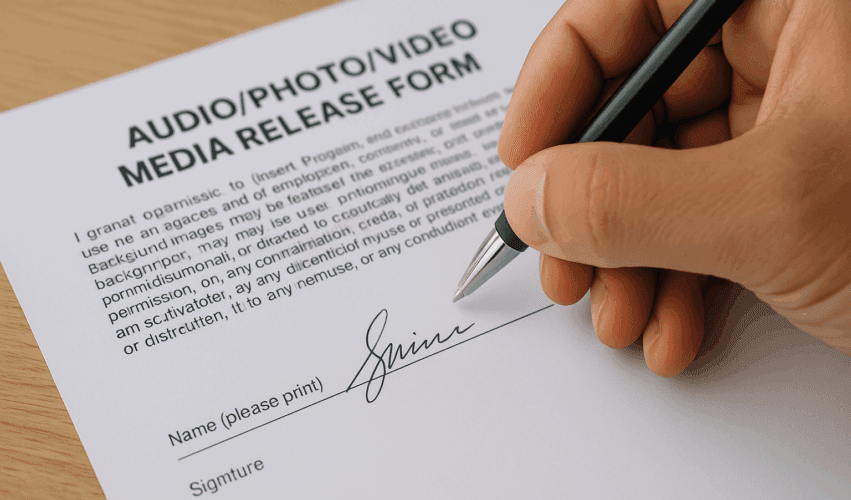
When you film staff, customers, or members of the public, you are dealing with people’s identities and personal information. A clear release process protects the organisation, the project, and the people on camera. It also avoids delays, misunderstandings, or uncomfortable conversations on the day of filming.
Many Melbourne businesses ask us the same questions. Who needs to sign? What needs to be included? Can someone withdraw permission later? How does this work in a workplace setting?
This guide by Dream Engine explains the practical side of release forms for corporate and government video production. It is not legal advice. Every organisation has its own requirements, so it is always best to speak with your legal team if you are unsure.
Why release forms matter for business and government projects
Corporate and organisational videos are often used for recruitment, onboarding, internal communication, websites, social media, and presentations. Once published, they can circulate widely. A signed release form creates clarity around:
- permission to appear in the video
- how the footage will be used
- whether it may be shared publicly
- whether the organisation can repurpose the content later
- what happens if a staff member leaves the company
Without a release form, you risk someone objecting to their appearance after filming. This can limit how the video is used or require expensive re editing.
Who needs to sign a release form
In most corporate projects, only key on-camera participants need to sign. These are the people who:
- appear in interviews
- speak to camera
- feature in role plays
- demonstrate a process
- appear clearly and intentionally in the final edit
Background staff walking through an office generally do not require a release form. If an organisation has specific compliance or privacy protocols, they may request broader coverage.
For anyone under eighteen, a parent or guardian must sign on their behalf.
Use your organisation’s approved release form
Dream Engine does not supply release forms because every organisation has its own legal standards, privacy obligations, and risk considerations. Instead, we guide clients on best practice and recommend that they use a version approved by their legal or HR team.
This ensures:
- the wording complies with internal policy
- privacy and confidentiality requirements are met
- the organisation is fully protected
- nothing is signed that Dream Engine cannot vouch for
If you do not already have a release form, your legal team can usually supply one quickly.
When and how to collect signatures
The smoothest approach is to collect signatures on the day of filming.
It keeps administration simple and avoids long email chains. It also ensures people sign with a clear understanding of the project, because they are physically present and can ask questions.
Most organisations use printed copies. Digital signatures are fine, too, if you prefer. All that matters is that the form is clear, readable, and stored in a central location within your organisation.
What a release form normally includes
Every organisation’s form is different, but most include:
- the person’s name and role
- the purpose of the video
- the content being released, such as video, audio, or photography
- permission to publish and distribute the content
- permission to repurpose the content in the future
- a statement that permission cannot be revoked after signing
- any limits the organisation wishes to specify
- a signature and date
Your legal team may add clauses for privacy, confidentiality, copyright, or specialised areas such as healthcare or government communications.
Can someone withdraw permission later?
This is a question that often comes up. In most cases, once a release form is signed and the video is produced, the organisation is not required to remove or re-edit the content.
However, this depends on the wording of your specific form. Some organisations choose to allow removal in sensitive situations. Others do not. Always follow your legal team’s guidance.
Filming in workplaces and sensitive environments
Some locations have additional requirements, including:
- healthcare facilities
- government departments
- schools
- research organisations
- sites with confidentiality or security protocols
In these cases, release forms may be combined with:
- privacy statements
- confidentiality agreements
- access permissions
- identity verification procedures
Dream Engine works regularly in settings with strict controls and will coordinate with your internal team to ensure everything runs smoothly.
How Dream Engine supports your release process
While we do not provide or approve legal documents, we help clients manage the release workflow to keep filming stress-free. This includes:
- advising who needs to sign
- reminding coordinators before filming day
- checking that all participants are aware of the process
- allowing time in the schedule for signing
- working with your legal or HR team if needed
When the release process is handled well, your organisation gains the confidence to use the video across multiple channels without hesitation.
Final note
This guide is general in nature. For formal advice or legal interpretation, always speak with your organisation’s legal department.
If you are planning a new video project and want a reliable, well-organised production experience, contact the Dream Engine team today.
Frequently Asked Questions
Do I always need a signed release form?
Most organisations only need release forms for people who appear clearly in the final video. Anyone interviewed or featured prominently should sign. Background staff usually do not need to sign unless your organisation has specific compliance or privacy requirements.
Do staff members need to sign release forms?
Yes, if they appear in interviews or are featured in the video. Staff who walk through the background of a scene generally do not need forms, unless your internal policy states otherwise.
Should I get people to sign before or on the filming day?
Collecting signatures on the filming day is usually the smoothest approach. It keeps administration simple and ensures participants understand the project and can ask questions before signing.
Do I need release forms for people in public places?
People who appear incidentally in the background of a public place generally do not require release forms. If someone is interviewed or featured directly, you should obtain their permission.
What if the person is under 18?
A parent or legal guardian must sign on behalf of anyone under eighteen. Schools and childcare environments may have additional requirements.
What should a release form include?
A release form typically includes the person’s name, the purpose of the video, permission to use and distribute the footage, permission to repurpose the content later, any specific limitations, and a signature and date. Your legal team may add clauses for privacy or confidentiality.
Can someone revoke their permission after filming?
In most cases, once a form is signed and the video is produced, the organisation does not need to remove or re-edit the content. This depends on your specific form. Always check with your legal or HR team.
Do I need a different form for voice-only recordings?
Some organisations prefer a separate form for voice-only work. Others include audio in their standard media release. Use the version approved by your legal team.
Should Dream Engine provide the release form?
We guide clients on best practice, but filming permissions and legal releases must come from the organisation. Every business has its own legal standards, privacy requirements, and risk considerations, so it is best to use a form approved by your legal or HR department.
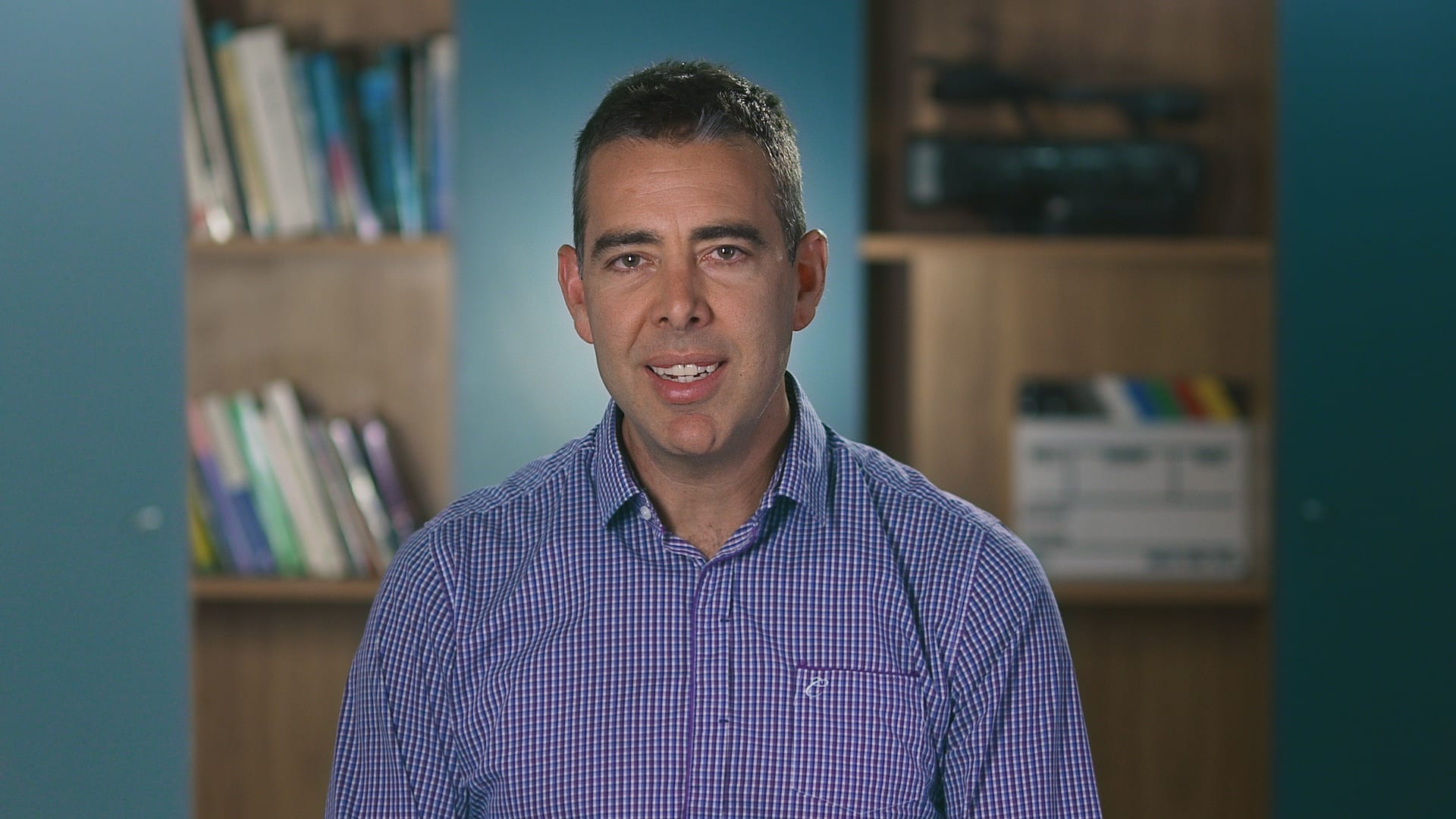
Ryan Spanger is the founder and managing director of Dream Engine, a Melbourne-based video production company established in 2002. With more than two decades of experience, Ryan has helped leading Australian businesses, government departments, and non-profits communicate their message with clarity and impact through video. He’s known for his strategic approach, reliable process, and commitment to producing videos that deliver measurable results.