This post explains what’s involved in requesting raw footage from your Dream Engine shoot. It outlines what raw footage is, why it looks different from a finished video, and what to consider before deciding if it’s right for your team.
At Dream Engine, where possible, we provide clients with raw footage from their shoots. We know it can be valuable if you plan to create future edits or want to archive everything we captured.
Before we share the files, it’s important to understand what you’ll be receiving and what’s involved in handling it. Raw footage isn’t like a finished video that plays easily on your laptop. It’s professional material created for video editing, and there are a few things worth knowing before requesting it.
1. The Files Are Very Large
Raw video files take up a significant amount of storage space. A single project can easily run into hundreds of gigabytes.
This means:
- You’ll need a fast and stable internet connection to download the files.
- The transfer can take many hours, or even days, depending on your internet speed.
- You’ll need ample hard drive space to store and back up the footage.
If your team plans to work with the material, large-capacity drives and a reliable backup system are essential.
2. The Footage Will Look Flat or “Grey”
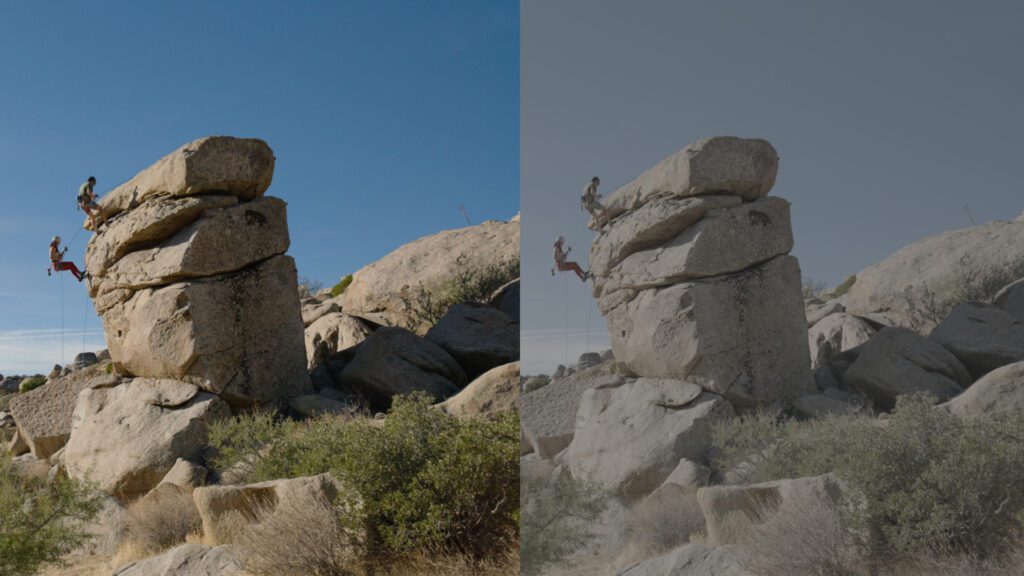
When you first open the files, the images may look pale or washed out. This is intentional. Our videographers shoot in a professional colour profile called LOG, which captures a wider range of detail in both highlights and shadows.
Shooting in LOG allows us to create the polished, cinematic look you see in the final edit.
If you or your team plan to edit the raw footage, you’ll need to:
- Apply a LUT (Look-Up Table) to restore colour and contrast.
- Use editing software that supports LOG footage, such as Adobe Premiere Pro, DaVinci Resolve, or Final Cut Pro.
Without applying a LUT, the footage will continue to look flat, which can be confusing if you haven’t worked with LOG material before.
Below you can see an example of colour-graded footage (left) vs LOG footage (right):
3. You’ll Need the Right Software and Hardware
We record using professional video codecs that offer flexibility and quality in post-production. To view and edit these files properly, your computer needs to be appropriately specified.
Your setup should include:
- Up-to-date video codecs installed on your system.
- A processor and graphics card capable of handling 4K or higher resolution footage.
- Fast storage, such as SSDs or RAID arrays, with plenty of free space.
If you’re unsure whether your system can handle the files, we’re happy to advise you before transferring them.
4. Support Beyond Delivery
We’re happy to supply raw footage when requested. However, technical support and troubleshooting are not included in standard delivery.
If you’d like help setting up your editing environment, installing codecs, or working with LOG footage, this can be provided as an additional service. We can also prepare the footage in a more accessible format if needed.
5. Alternative Delivery Option: Couriered Hard Drive
If downloading the files isn’t practical, we can supply a hard drive and have it couriered directly to you. This avoids long download times and ensures you receive the full-quality files securely.
Please note that this service sits outside the scope of the original project and is charged separately. If you’d like us to handle this for you, contact us for a quote and we’ll recommend the most efficient option.
Next Steps
We want you to get the most value from your video production. Understanding what’s involved in working with raw footage will help you decide whether it’s the right option for your team.
Ryan Spanger is the founder and managing director of Dream Engine, a Melbourne video production company established in 2002. Over the past two decades, he’s produced hundreds of videos for businesses, government departments, universities and healthcare organisations across Australia. Ryan specialises in helping organisations explain complex ideas through clear, engaging video content, with particular experience in corporate communications, training and education.