Training plays a critical role in healthcare. Whether it’s onboarding new staff, reinforcing best practices, or managing risk, the way information is delivered can have a direct impact on patient care and safety.
A recorded demonstration gives staff the same explanation of a task and a resource they can revisit. Clinical staff need to check the instructions before release and when procedures change.
At Dream Engine, we’ve worked with healthcare organisations to produce training videos in Melbourne across clinical communication, equipment use, and infection control. The examples below show how training videos can be used effectively in real healthcare settings.
Why Training Videos Are Well Suited to Healthcare
Healthcare teams need training that fits around clinical work and remains available when staff join or procedures change. The content needs clinical review, with enough detail to explain the task and its limits.
Training videos are particularly effective when organisations need to:
- Deliver consistent information across teams and locations
- Support onboarding without relying on senior staff availability
- Reinforce correct procedures and behaviours over time
- Address sensitive or high-risk topics carefully and clearly
Healthcare organisations use video to make training more consistent and accessible across teams, departments, and locations. Video also allows real-world situations to be demonstrated in a way that written documentation often cannot.
Example 1: Communications Training for Intensive Care Clinicians
We worked with the College of Intensive Care Medicine, the specialist medical college responsible for training and accrediting intensive care doctors in Australia and New Zealand.
The project involved producing a series of short training videos for an online Communications course designed for clinicians working in high-pressure clinical environments. Filming took place over two days onsite at the college and resulted in 10 to 15 short videos, each 2 to 3 minutes in length, structured for delivery within an online learning platform.
Dream Engine worked closely with the college to shape a format that balanced realism with clarity. Given the sensitive nature of the subject matter, the focus was on creating scenarios that felt authentic without being confronting, and on presenting information in a way that supported reflection and learning.
The course addressed complex communication scenarios, including:
- Breaking bad and catastrophic news
- Shared decision-making and resuscitation discussions
- Open disclosure following adverse events
- Giving and receiving feedback
- Cross-cultural communication, including working with Aboriginal, Torres Strait Islander, and Māori people
Actors were provided by the college, allowing scenarios to be carefully scripted and controlled. Our role was to manage filming, guide performances to suit a training context, and edit the content into clear, self-contained modules ready for online delivery.
This project shows how short, well-structured training videos can support nuanced communication skills in healthcare, where consistency and sensitivity are essential.
“Ryan and his team knew exactly the storyline and the whole production process was made so much easier for me and everyone involved internally and externally. As promised Dream Engine has delivered us with a strong and compelling production and we have received very good feedback from people involved. I would highly recommend their services to anyone and take this opportunity to thank Ryan and Jove for their patience and support.”
Sumithra Abeygunasekera, STP Co-ordinator, CICM
Example 2: Equipment Training Across Multiple Ambulance Services
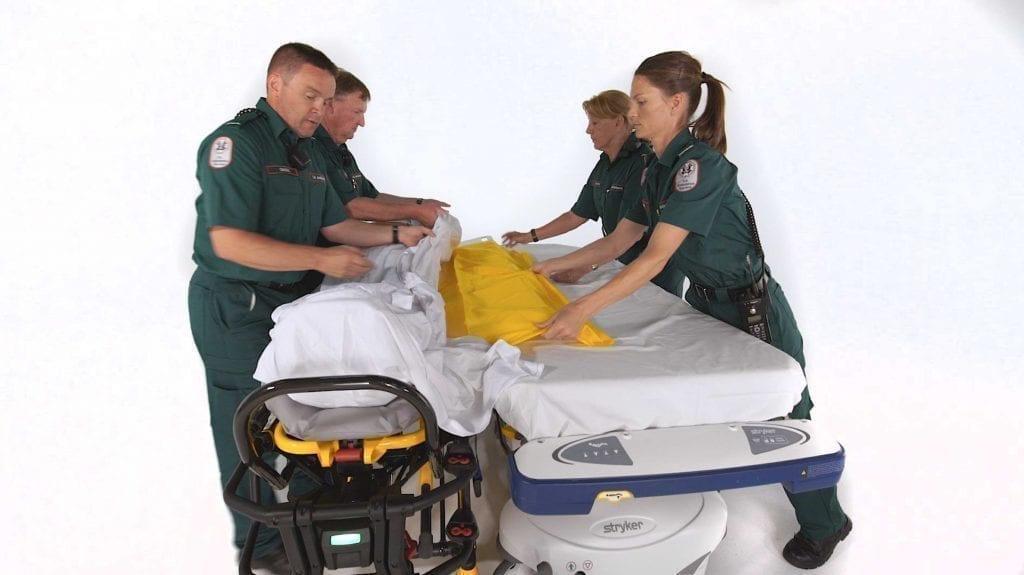
We produced a comprehensive series of training videos for Stryker, a global medical technology manufacturer whose equipment is widely used by ambulance and emergency services.
The training focused on the safe and correct use of Stryker’s Power-PRO stretcher range within Australian ambulance services. Filming took place across Victoria, South Australia, and Queensland, with each series adapted to reflect how teams in that state operate.
Rather than creating a single generic training video, Dream Engine worked with Stryker to develop state-specific versions that accounted for differences in procedures, environments, and workflows. This ensured the training felt immediately relevant to the people using the equipment.
The videos featured local ambulance personnel, filmed in state-specific uniforms, using the equipment in realistic operational settings. Our role included planning and managing multi-location shoots, maintaining consistency across all content, and shaping the material to remain clear and practical despite regional differences.
The training emphasised:
- Paramedic and patient safety
- Correct handling and operation of powered stretchers
- Consistent technique across teams and shifts
This project demonstrates how training videos can be scaled nationally while still respecting local practices, which is critical in safety-focused healthcare environments.
“The South Australian Ambulance Service has been mesmerised by your skills and craft and appreciative of your professionalism.”
Meredith Knowler
Manager, Infrastructure Planning & Improvement, South Australian Ambulance Service
Example 3: Maintenance and Infection Control Training in Dental Practices
We also produced a series of training videos for Cattani focused on proper maintenance and cleaning of their Smart Suction System used in dental surgeries.
The videos were designed to support dental teams with routine maintenance tasks that directly impact hygiene, compliance, and equipment performance.
Dream Engine worked with Cattani to translate technical maintenance requirements into clear, practical training content. The emphasis was on showing procedures step by step, in context, rather than relying on written manuals or diagrams.
The training content covered:
- Daily and regular maintenance routines
- Correct cleaning procedures to support infection control
- Best-practice use of the suction system within a working surgery
- How consistent maintenance supports patient safety and equipment longevity
By filming in a real clinical environment and focusing on clarity, the videos were designed to support both onboarding and ongoing reinforcement of correct procedures.
Common Patterns We See in Effective Healthcare Training Videos
Across these projects, a few consistent principles emerge.
Effective healthcare training videos are:
- Short and focused, allowing content to be revisited easily
- Filmed in relevant environments, so staff can recognise the equipment, setting and procedures being demonstrated
- Structured for learning, with clear modules and practical examples
- Built for repeat use, not one-off viewing
Each video should explain a defined task or situation, with the clinical team checking the steps, terminology and context before staff use it in training.
Where Training Videos Fit Best in Healthcare
Training videos work particularly well for:
- Onboarding new staff
- Standard operating procedures
- Equipment use and maintenance
- Communication and behavioural training
- Compliance and risk management
For example, an onboarding video can introduce the workplace and its routines, while an equipment video can show a specific task step by step. Role-play scenarios let staff discuss communication choices and how they would respond in a similar situation.
They are most effective when used alongside other forms of training such as supervised practice, mentoring, and in-person discussion.
Need Help Creating Healthcare Training Videos?
Start with the procedure or situation staff need to learn. Agree on who will check the clinical content, what must be demonstrated and where staff will watch the finished modules.
At Dream Engine, we work with healthcare organisations to produce professional training videos that support onboarding, compliance, clinical education, and staff development. From planning and scripting through to filming and editing, we can help you create training content that delivers a consistent learning experience across your organisation.
Learn more about our training video production services.
Planning your training videos
Frequently asked questions
Practical answers about filming, structuring and updating healthcare training videos.
How long should a healthcare training video be?
For most healthcare training, shorter modules work best. We often recommend breaking content into 2 to 5 minute segments so staff can complete training in small blocks and easily revisit specific topics later.
Can training videos cover sensitive topics in a respectful way?
Yes. The key is careful planning of tone, scenario design, and performance direction, combined with an editing approach that supports learning rather than drama. For sensitive topics, we work with your subject matter experts to ensure the content is accurate and appropriate.
Do you film training videos on location in hospitals, clinics, or colleges?
We regularly film on location. We plan around operational needs, access requirements, and infection control expectations. Where needed, we can also film in controlled environments that still reflect real clinical settings.
Should we make one long training video or a series?
A series is useful when staff need to revisit individual tasks or complete separate learning activities within an LMS. A longer video may suit a connected scenario or demonstration. Choose the structure around the learning objective, and assess understanding through the wider training program.
Can training videos be updated as procedures change?
Yes. We can design training videos so they’re easier to refresh over time, including modular structure, consistent templates, and clear asset naming. This allows individual sections to be updated without rebuilding the entire program.
Ryan Spanger is the founder and managing director of Dream Engine, a Melbourne video production company established in 2002. Over the past two decades, he’s produced hundreds of videos for businesses, government departments, universities and healthcare organisations across Australia. Ryan specialises in helping organisations explain complex ideas through clear, engaging video content, with particular experience in corporate communications, training and education.