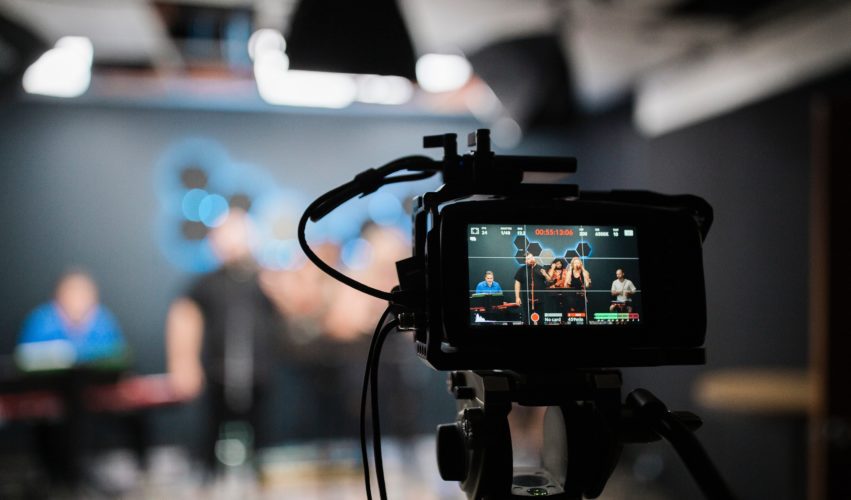
Executive summary: Livestreaming leaves no room for error. This article explains how professional live streaming teams in Melbourne and across Australia design systems, plan redundancy, and manage technical risk to ensure stable, uninterrupted delivery when filming live event video in Melbourne.
When a livestream runs smoothly, it feels simple. The picture is stable, the sound is clear, speakers appear when they are meant to, and the stream continues without interruption. Viewers focus on the content rather than the technology delivering it, which is exactly the outcome you want.
What most people do not see is how much technical decision-making and preparation sits underneath that experience. Live streaming is one of the least forgiving forms of video production. Once you are live, every part of the system is under continuous load and any weakness tends to surface quickly.
This article explains what is at stake with livestreaming, the most common technical failure points we see in Melbourne and across Australia, and the practical systems we put in place to ensure reliability without unnecessary complexity.
Professional Live Streaming Carries Real Risk
Livestreaming removes the safety net that exists in pre-recorded video. If something goes wrong, there is no opportunity to pause, reset, or fix it quietly. The event keeps moving and the audience is already watching.
In Australia, livestreams are often used for important events: Government briefings, streamed company awards, healthcare communications, corporate town halls, annual meetings, and public-facing announcements. These are not environments where a brief dropout or garbled audio can be brushed aside.
From a technical perspective, this means systems must be designed to run continuously and predictably rather than optimised for short bursts of performance. Reliability becomes the primary design constraint.
The Real Consequences of a Failed Livestream
When a livestream fails, the impact is immediate and visible. Viewers disengage quickly, particularly in remote or on-demand environments where there is no obligation to stay. Speakers lose confidence if they sense technical instability, and internal teams are left exposed with limited ability to recover in the moment.
In many Australian organisations, livestreams are also recorded and referenced later. A failure that occurs live can resurface repeatedly if the recording is incomplete or compromised. This makes reliability important not just for the event itself, but for everything that follows.
From a technical standpoint, this means planning for both live delivery and clean capture at the same time.
Common Livestream Failure Points in Melbourne and Australian Venues
Most livestream issues come from predictable technical constraints rather than unusual circumstances.
Internet connectivity is the most common risk. Many Melbourne venues provide internet that performs well for general use but struggles with sustained upload. Live streaming requires a consistent outbound data rate over an extended period. Shared networks, especially in conference centres, hotels, and civic buildings, can fluctuate significantly once an event begins.
Mobile connectivity is often used as a fallback, but coverage varies widely depending on location, building construction, and network congestion. Relying on a single cellular connection introduces unnecessary risk, particularly indoors.
Audio failures are another frequent issue. Wireless systems are sensitive to interference, battery condition, and gain structure. Poorly managed audio does not always fail outright, but it can degrade slowly, which is often worse because it goes unnoticed until viewers start leaving.
Video issues tend to originate from physical and configuration details. Loose SDI or HDMI connections, mismatched resolutions, frame rate conflicts, or cameras operating near their thermal limits can all interrupt a signal unexpectedly.
Power issues, while less common, can create cascading failures if critical systems share a single circuit. Human error also plays a role, particularly when roles are unclear or systems are being adjusted live without a clear process.
How We Design Reliable Live Streaming Systems
A stable livestream starts with system design rather than equipment selection. Before any gear is deployed, we define the signal path end to end. From camera and microphone, through switching and encoding, to the delivery platform and backup recording.
Internet is treated as a variable, not a given. We design streams around a target bitrate that allows headroom rather than pushing the maximum available bandwidth. Multiple independent connections are used where possible, and failover is configured so that a degraded connection does not immediately disrupt the stream.
Encoding is handled by dedicated hardware rather than relying solely on software running on a general-purpose computer. Hardware encoders are designed to perform a single task continuously, which reduces instability under sustained load.
Where appropriate, streams are monitored both locally and remotely. This allows issues to be identified from the viewer’s perspective rather than relying solely on internal indicators.
Technical Overview for Detail-Oriented Clients
A professional livestream is designed as a continuous, end-to-end system rather than a collection of individual components. Below is a simplified view of how a typical professional setup is engineered.
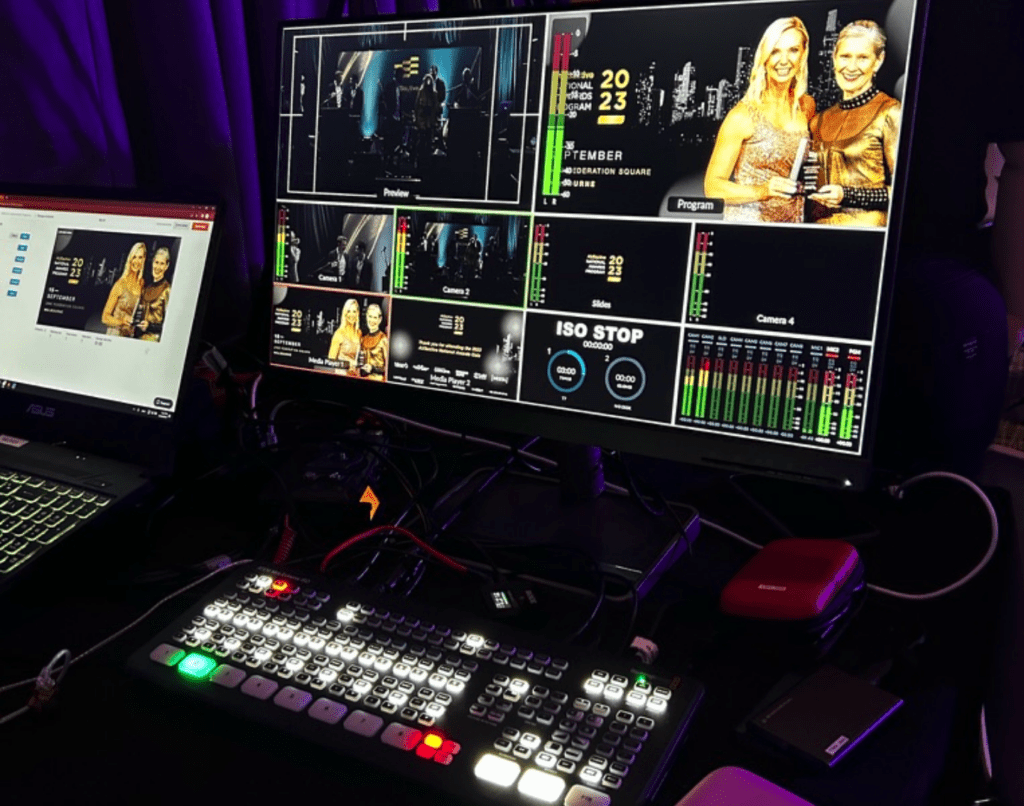
Signal flow: Cameras and microphones feed into a hardware switcher where video and audio are synchronised and monitored in real time. From there, the signal is sent to a dedicated hardware encoder that compresses the stream at a stable bitrate suitable for sustained delivery.
Internet and failover: The encoder outputs to a primary internet connection with one or more independent backup paths available. If the primary connection degrades or drops, traffic can be rerouted without interrupting the stream.
Audio handling: Audio is mixed separately with conservative gain structure and sufficient headroom to avoid distortion. Wireless systems are frequency-managed, batteries are replaced proactively, and backup microphones are kept live and ready.
Monitoring and redundancy: The stream is monitored locally and from an external viewer perspective. Independent recordings are captured in parallel so the content remains intact even if a live delivery issue occurs.
Operating margin: All systems are run below maximum capacity. Bitrates, temperatures, and power loads are kept within safe limits to reduce the risk of instability during long sessions.
Audio Engineering for Live Streaming
Audio is the most sensitive part of a livestream and the least forgiving when it fails. Viewers will tolerate a brief visual issue, but they disengage quickly if audio becomes unclear or drops out.
For this reason, audio systems are designed with margin rather than minimalism. Microphones are chosen for reliability and consistency rather than convenience. Wireless systems are coordinated to avoid interference. Batteries are replaced proactively rather than waiting for low warnings.
Audio levels are set with appropriate headroom to avoid distortion if a speaker suddenly raises their voice. Monitoring is continuous, not occasional, and backup audio paths are always available.
The aim is not perfect sound, but stable, intelligible sound for the full duration of the event.
Live Streaming Equipment and System Design
Livestreaming equipment must operate continuously, often for hours, without interruption. Cameras need to manage heat effectively. Switchers need to handle rapid transitions without delay. Capture and encoding systems need to remain stable under constant data flow.
We use equipment that is designed for this type of workload and we operate it well within its limits. Pushing systems to their maximum capacity increases the chance of failure. Leaving margin reduces it.
Cable management, power distribution, and physical layout are treated as part of the system design. Many livestream failures originate from simple physical issues that were not addressed early.
Redundancy in Professional Live Streaming
Redundancy is applied selectively. The focus is on removing single points of failure rather than duplicating everything.
Critical components such as internet connectivity, encoding, audio paths, and power are protected. Independent recordings are often captured alongside the live stream so that content is preserved even if the stream itself encounters an issue.
This ensures that the organisation is protected both during and after the event. A stable recording can be distributed immediately if required, regardless of what occurred live.
Crew Structure and Technical Oversight During Live Streams
Even well-designed systems require clear human oversight. Livestreams fail most often when one person is trying to manage too many technical responsibilities at once.
Roles are defined so that monitoring, switching, audio, and cueing are handled separately. This allows each part of the system to be watched continuously rather than intermittently.
Clear communication protocols mean that adjustments can be made quickly and calmly if something begins to drift.
Testing and Rehearsals for Live Streaming
Systems are tested in the conditions they will operate in, not just powered on and checked. Internet connections are stressed at the target bitrate. Audio is tested with real speakers and real movement. Switching and transitions are rehearsed.
This process reveals issues that would otherwise only appear once the stream is live. Resolving them early is far simpler and far less visible.
What Clients Rarely See Behind a Professional Livestream
Behind a smooth livestream is a large amount of quiet technical discipline. Configuration notes, checklists, labelled signal paths, pre-configured scenes, backup recordings, and constant monitoring throughout the event.
When everything works, none of this is visible. That invisibility is intentional. The technology is doing its job precisely because it is not drawing attention to itself.
Why Reliable Live Streaming Matters
Livestreams are often tied to moments that cannot be repeated. Public announcements, leadership communications, regulatory updates, and milestone events all rely on continuity and clarity.
When the stream runs smoothly, the technology disappears and the message carries the weight it should. When it does not, the delivery becomes the focus.
Final Thoughts
Reliable live streaming is the result of deliberate system design, conservative technical choices, and experience with real-world conditions in Melbourne and across Australia.
Most of the work happens before the cameras go live. Most of the success comes from problems that never surface.
That is what professional live streaming is meant to feel like.
Frequently Asked Questions About Professional Live Streaming
Why is internet redundancy so important for live streaming?
Live streaming requires a stable, continuous upload connection. Many venues in Melbourne and across Australia cannot guarantee this on a single network, especially once an event begins. Redundant internet paths allow the stream to continue even if one connection degrades or drops.
What makes professional live streaming equipment more reliable?
Professional live streaming equipment is designed to run continuously under load. Hardware encoders, broadcast cameras, and dedicated switchers are more stable over long sessions than consumer or software-only setups, reducing the risk of crashes or overheating.
Why is audio treated as more critical than video in a livestream?
Viewers will tolerate brief visual issues, but they disengage quickly if audio becomes unclear or drops out. For this reason, professional livestreams prioritise reliable microphones, conservative audio levels, and backup audio paths throughout the event.
Ryan Spanger is the founder and managing director of Dream Engine, a Melbourne-based video production company established in 2002. With more than two decades of experience, Ryan has helped leading Australian businesses, government departments, and non-profits communicate their message with clarity and impact through video. He’s known for his strategic approach, reliable process, and commitment to producing videos that deliver measurable results.